

Blog
Which Search Coil Should I Use and Where?
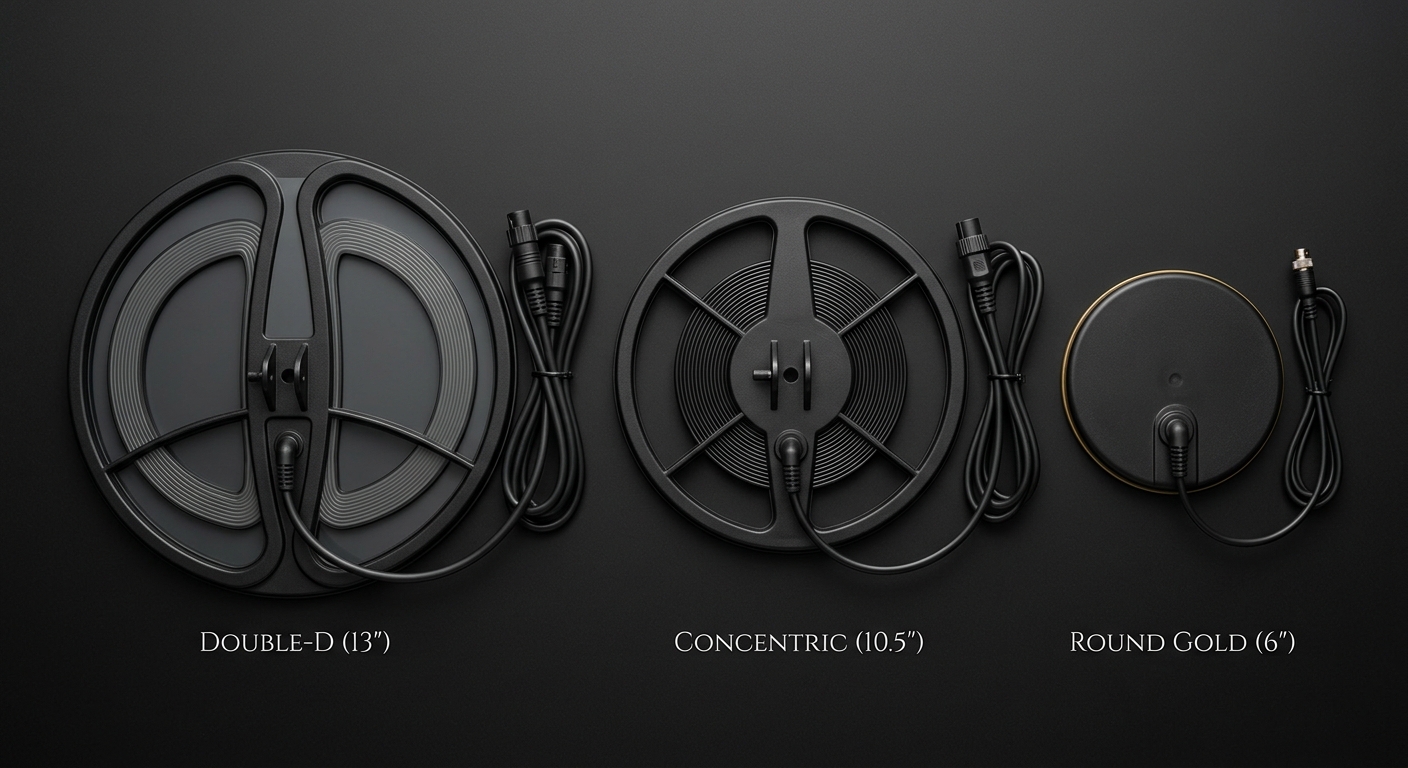
The search coil is the part of your metal detector that actually “sees” into the ground. Choosing the right coil for your location can add depth, improve target separation and save you hours of digging trash. In this guide we explain coil sizes, the three main coil configurations and which search coil to use where.
How a Search Coil Works
A search coil contains transmit and receive windings. The transmit winding creates an electromagnetic field; when that field meets a metal object, the object creates its own small field, which the receive winding picks up. The size and winding layout of the search coil decide how deep, how wide and how precisely your detector can detect. You can read more about the physics in this overview of how metal detectors work.
Small vs. Large Search Coils
Small Search Coils (up to about 20 cm)
Small coils excel in trashy ground such as parks and iron-riddled fields thanks to superior target separation. They are light, easy to swing for long sessions and ideal for tight spaces like woods, between rocks and for water hunting thanks to lower drag. The downside is a narrower sweep and less depth on larger targets.
Standard Search Coils (about 22–28 cm)
The stock coil on most detectors is a compromise between depth, coverage and separation. For most beginners it is the best all-round coil and the right place to start.
Large Search Coils (30 cm and more)
Large coils provide deeper detection on bigger targets and cover ground much faster, which makes them ideal for wide-open, clean fields, beaches and prospecting for deep nuggets. They are heavier, less sensitive to tiny targets and struggle in trashy areas.
Search Coil Configurations Explained
Double-D (DD) Coils
DD coils perform exceptionally well in mineralized or salty soil while keeping a broad, knife-edge detection field. They are the most popular choice for gold prospecting and relic hunting in difficult ground.
Concentric Coils
Concentric coils offer the most precise pinpointing and target identification and slightly better depth in mild soil, but they require slower swing rates and react more to ground mineralization.
Monoloop Coils
Monoloop coils are mainly used on Pulse Induction (PI) detectors to achieve maximum depth. They are a favourite of gold prospectors who search for deep nuggets in highly mineralized goldfields.
Which Search Coil Should I Use? Quick Guide
- Parks, schoolyards and trashy sites: small DD or concentric coil for separation
- Ploughed fields and pastures: standard or large DD coil to cover ground
- Beaches and wet sand: DD coil, larger size for dry sand, waterproof for the surf
- Gold prospecting in mineralized ground: DD or monoloop coil, small for tiny nuggets, large for depth
- Woods, rocks and tight spots: small “sniper” coil
Protect Your Search Coil
The coil touches the ground all day, so it wears quickly. A coil cover protects it from scratches, stones and moisture and costs far less than a replacement coil. Find spare coils and covers in our search coils and coil protection category.
Search Coils for Professional Detectors
Many professional gold detectors such as the Minelab GPZ 7000 are designed to work with specialised coils for maximum depth. Explore our pulse induction and VLF detectors, or read how to choose the right gold detector.
Conclusion
There is no single best coil. Use a small coil for trashy ground and tight spaces, a standard coil for general detecting and a large coil for open fields and depth. Match the coil configuration to your soil – DD for mineralized ground, concentric for precise ID, monoloop for PI depth – and your detector will perform at its best.